The quick version
Buy a 12–16 lb Choice or Prime packer, trim the fat cap to 1/4 inch, and season heavy with a 50/50 Dalmatian rub of coarse kosher salt and 16-mesh pepper. Smoke at 225–250°F over post oak, budget 1 to 1.5 hours per pound, and wrap in peach butcher paper around 165°F once the bark is set. Start probing at 195°F and pull between 195 and 203°F only when the probe slides in like room-temperature butter — then rest 1 to 2 hours in a dry cooler and slice the flat pencil-thin against the grain.
Brisket is the meat that separates the backyard hopeful from the pitmaster, and it earns that reputation honestly. It's a big, cheap, tough slab of a cut that punishes shortcuts and rewards patience. Get it right and you'll pull pencil-thin slices that bend, glisten, and hold a smoke ring you could frame. Get it wrong and you've spent fourteen hours making expensive pot roast.
Here's the good news: none of it is complicated. Brisket is not a recipe, it's a process — trim, season, smoke, wrap, rest, slice. Nail the temperatures and read the meat instead of the clock, and your first packer will beat most barbecue-joint brisket in America. Let's build one from the cooler up.
A whole brisket is called a packer, and it's actually two muscles stacked and separated by a seam of fat. The flat is the long, lean, rectangular muscle — that's where your clean slices come from.
The point (also called the deckle) sits on top, fatter, more marbled, and more forgiving; it's what you cube for burnt ends. A good packer weighs 12 to 16 pounds before trimming. Anything much smaller has usually had the point cut off, and a lone flat is far harder to keep moist.
You'll see flats sold on their own for less money and less hassle. Skip them for your first few cooks. The point's fat renders down and bastes the flat during the long haul, and it gives you a built-in margin for error. Buy the whole packer. If you can find USDA Choice or Prime with good flexibility and a thick, even flat, you're already ahead.
Grab the brisket by one end and let it drape over your hand. A quality packer flops and bends easily — that flexibility means good intramuscular fat and connective tissue that'll break down beautifully. A stiff board of a brisket is a warning sign.
Trim cold. A brisket straight from the fridge (or 20 minutes in the freezer) firms the fat and makes clean cuts far easier. Use a sharp boning or trimming knife, and give yourself a big cutting board.
Your goals, in order:
Expect to remove 1 to 2 pounds of trimmings. Save the clean fat — you can render it into tallow to brush on later, or freeze it for grinding into burgers.
Central Texas figured brisket out a century ago, and the seasoning is almost aggressively simple. It's called Dalmatian rub for its black-and-white speckle: equal parts coarse kosher salt and 16-mesh black pepper. That's it. No sugar (it burns over a 14-hour cook), no fillers, nothing to hide behind. Beef, smoke, salt, pepper.
The 16-mesh grind matters. It's coarser than table pepper, so it clings to the surface, builds texture into the bark, and won't turn bitter. Mix a 50/50 blend — about a cup total for a big packer — and apply it heavily.
You want full, even coverage on all sides with the meat just barely showing through. Season the fat cap too. If you want to nudge it, a little coarse granulated garlic is the only addition a Texan will forgive. Want to understand exactly why this ratio works and how to scale it to other meats?
That's the whole point of building your own rub.
Apply the rub 1 to 12 hours ahead and let it sit uncovered in the fridge. The salt draws moisture to the surface, dissolves, and gets reabsorbed — a light dry brine that seasons deeper than a surface coat. If you're pressed, seasoning right before the smoker still works fine.
Competition cooks and anyone smoking a leaner Choice brisket often inject for insurance against dryness. A simple, effective blend: beef broth, melted unsalted butter, and a splash of Worcestershire sauce.
Use a meat injector and go in at roughly 1 ounce per pound, working in a grid pattern about an inch apart, pushing the plunger as you slowly pull the needle out. Inject with the grain, not across it, so the liquid follows the muscle fibers.
Do it in a pan — it gets messy — and season after you inject. An injection isn't mandatory, especially on a well-marbled Prime packer, but it's cheap insurance if dry brisket has burned you before.
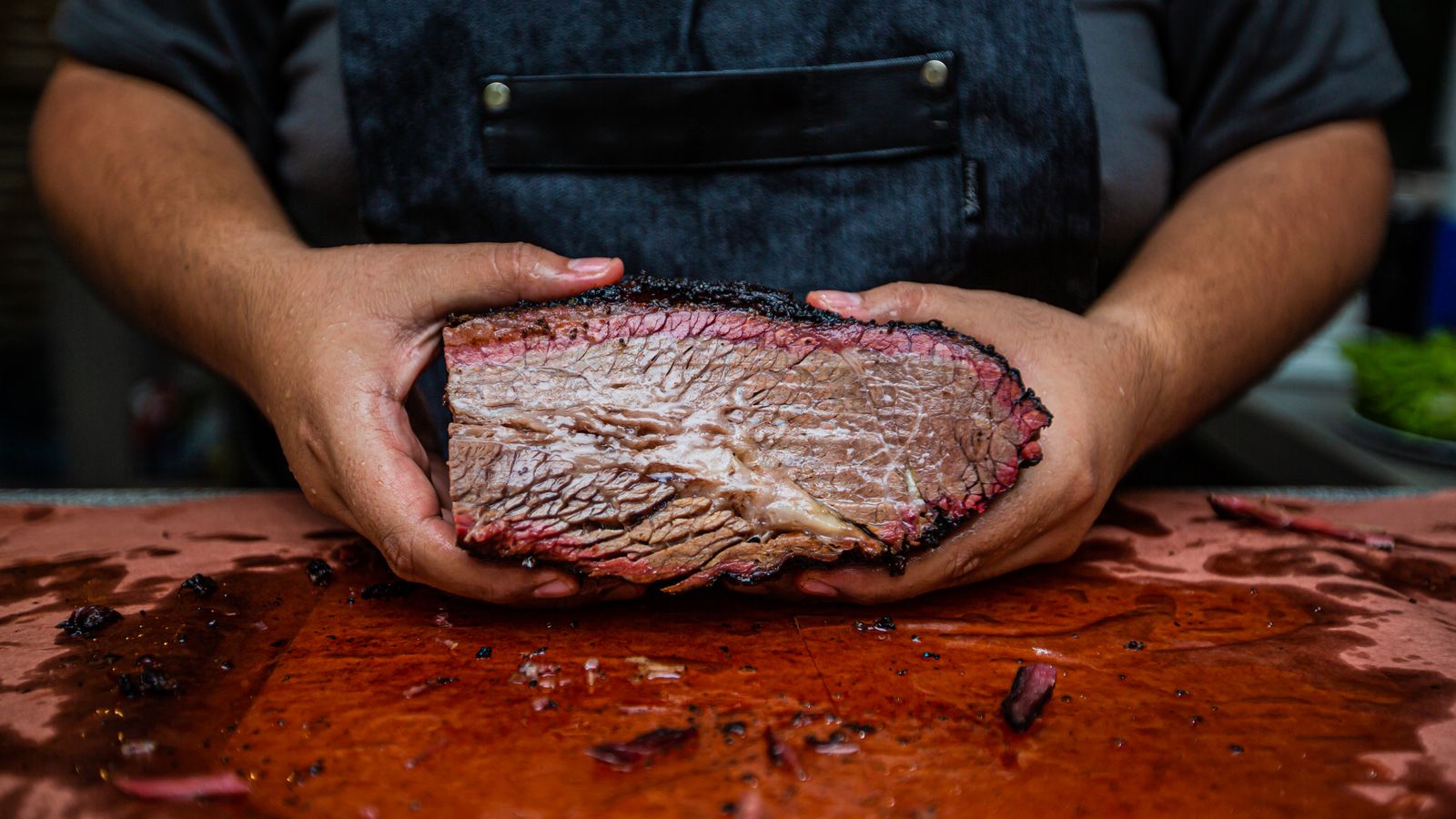
Brisket is the flagship of low and slow cooking. Run your pit at a steady 225 to 250°F (107–121°C). Lower gives you a touch more smoke and bark development; higher gets you done sooner with barely any loss in quality. Most people land at 250°F as the sweet spot between quality and not staying up for 20 hours. Whatever you pick, hold it steady — swings are what wreck a cook.
For fuel, post oak is the classic Texas brisket wood: clean, mild, steady heat that complements beef without overpowering it. Hickory works and hits a little harder; a few chunks of pecan or cherry are fine too. Avoid mesquite for a cook this long — it turns acrid over many hours.
Whatever your smoker, you're running an indirect, two-zone setup: the meat never sits over direct flame.
Whether you're on an offset, a pellet grill, a kamado, or a bullet smoker, the target temp is the same — the fuel and fire management differ, which is exactly what the different smoker types come down to.
Set the brisket on fat-side up if your heat comes from below (most vertical and pellet smokers) so the rendering fat bastes down through the meat; go fat-side down if your heat radiates from one side or the firebox, to shield the flat.
Add a water pan to stabilize temps and keep the environment humid, which helps smoke adhere and slows the surface from drying out. Plan on 1 to 1.5 hours per pound — a 14-pound packer runs roughly 12 to 18 hours. But that's a planning number, not a doneness rule.
The meat decides when it's done, not your watch.
Grab the free doneness + wood-pairing cheat sheet →Somewhere around 150 to 170°F (66–77°C) internal, your brisket's temperature will stop climbing. It may sit dead still — or even drop — for two, three, sometimes four hours. This is the stall, and it breaks the spirit of every rookie who thinks something's broken. Nothing is broken.
The stall is evaporative cooling, plain and simple. As the meat heats, moisture wicks to the surface and evaporates, and that evaporation pulls heat away at almost exactly the rate your fire is adding it — like sweat cooling your skin.
The temperature stalls until the surface dries enough for the meat to start climbing again. It's the same physics every time, and it's why the stall is the single most misunderstood moment in barbecue. Don't crank the heat. Don't open the lid every ten minutes. Be patient, or wrap to push through it.
Wrapping ends the stall by trapping moisture against the meat and stopping evaporative cooling. The key is when: wait until the bark is set — a deep mahogany color that doesn't smear when you touch it, usually around 165°F internal. Wrap too early and you steam off the bark you worked hours to build.
| Method | Bark | Speed | Best for |
|---|---|---|---|
| Peach butcher paper | Stays firm; breathes a little | Moderate — beats the stall, keeps texture | The classic Texas choice; best all-around bark |
| Aluminum foil | Softens (the "Texas crutch") | Fastest — fully seals in steam | Speed and moisture when you're behind schedule |
| No wrap ("naked") | Thickest, hardest bark | Slowest — full stall | Maximum bark, if you've got the time |
Peach (unbleached) butcher paper is the pitmaster's default because it protects the meat and beats the stall while still letting the bark breathe, so it stays firm instead of turning to mush. Foil — the "Texas crutch" — is faster and juicier but softens the bark; reach for it when you're racing the clock. Wrap snugly, seam-side down, and return the brisket to the pit.
Here's the rule that matters most: brisket is done by feel, and temperature just tells you when to start checking. Start probing at 195°F, and expect the magic window between 195 and 203°F (91–95°C). But the number alone won't save you — two briskets can hit 200°F and one be perfect, the other tough.
The real test is probe tenderness. Slide an instant-read thermometer or a thin skewer into the thickest part of the flat. When it's done, the probe slides in and out with zero resistance — like pushing into room-temperature butter. If it drags or catches, the collagen hasn't fully broken down.
Give it another 30 to 45 minutes and check again. Trust the feel over the number every time. Keep a good instant-read thermometer in your hand for this — a leave-in probe tracks the cook, but the final call is made by feel across several spots.
For a full breakdown of pull temps versus safe minimums on every cut, keep the meat temperature chart handy.
Probe the flat, not the point. The point is fattier and softens sooner, so it'll feel done while the leaner flat is still tight. The flat is the harder muscle to get tender, so let it be your judge.
You've cooked for 14 hours — now you're going to wait some more, and this step is not optional. Pull the brisket, leave it wrapped, and vent it for a few minutes so it stops carrying heat past done. Then rest it 1 to 2 hours — longer for a big packer.
The best tool for this is a dry (empty) cooler. Wrap the brisket in a towel, set it in an empty cooler, close the lid, and walk away. It'll hold above 140°F — the food-safe line — for hours.
During the rest, the muscle fibers relax and reabsorb the juices that heat pushed out; carve too soon and those juices run onto the board instead of staying in the slices.
A properly rested brisket holds happily at serving temp anywhere from one to four hours, which also makes timing a big cook far less stressful. There is no downside to a long rest, and there is a huge downside to skipping it.
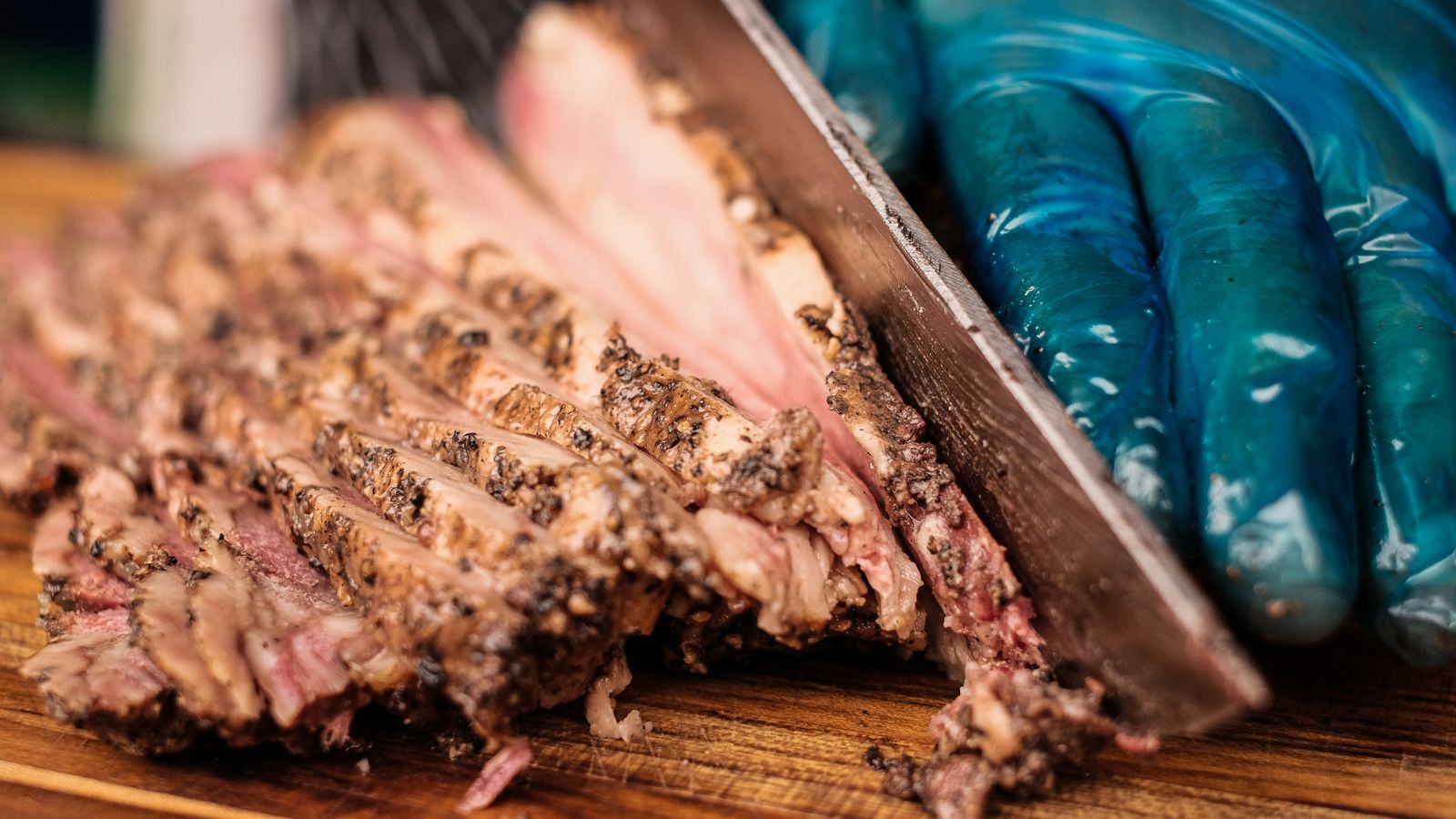
All that work comes down to the knife. The single biggest slicing mistake is cutting with the grain — leaving long muscle fibers intact and chewy. You always slice against the grain to cut those fibers short and tender.
The catch: the point and flat run in different directions, so you can't slice the whole packer one way. Here's the move:
Slice only what you'll serve right away — brisket dries out fast once it's cut and exposed. Serve it plain (Texas-style, the meat speaks for itself) or with a good regional sauce on the side. Round out the plate with proper BBQ sides and you've got a spread worth the wait.
If your slices come out dry or tough, it's almost always one of these: you pulled it early and the collagen never rendered (go by probe feel, not the clock); you didn't rest it long enough; you sliced with the grain; or you cooked a lean flat with no injection and no wrap.
Toughness is undercooked — put it back on. Dryness is usually overcooked, under-rested, or sliced too early. Both are fixable once you know the cause, which is why brisket rewards a few cooks of practice. Feeling ready for something lower-stakes first?
A smoked pork butt is far more forgiving and teaches the same low-and-slow rhythm.