The quick version
Santa Maria tri-tip is a reverse sear: season with salt, pepper, and garlic, smoke at 225-250°F over oak to 120-125°F internal, then blast it 60-90 seconds per side over 450-500°F+ direct heat and pull at 130-135°F for medium-rare. Rest 10-15 minutes, then find the seam where the grain flips mid-roast, split it in two, and slice each half against its own grain — skip that and the knife undoes the whole cook. All in, it’s a 1.5 to 2 hour cook that makes a $10-a-pound cut eat like a $40 steak.
Tri-tip isn't from Texas, Kansas City, or the Carolinas. It's a Central California original, born on the ranches around Santa Maria, and it deserves better than the sad, gray-brown wedge most people char on a gas grill until it's the texture of a boot heel. Done right, tri-tip is a $10-a-pound cut that eats like a $40 steak: smoky bark outside, rosy pink all the way through, tender enough that you don't need a steak knife.
The method below is the real Santa Maria approach crossed with a reverse sear, which is the single best thing you can do for this cut. Give it two hours of your Saturday and you'll never go back to just throwing it on the grates and hoping.
Tri-tip is the bottom sirloin, specifically a small triangular muscle (some butchers call it the "triangle roast") that sits at the bottom of the sirloin primal, near the hip.
A whole tri-tip usually runs 1.5 to 2.5 pounds, is fairly lean, and has a loose, open grain compared to something like a ribeye. It was mostly ground into hamburger until the 1950s, when a Santa Maria butcher named Bob Schutz started cutting it whole and grilling it over red oak coals for customers.
It caught on locally, then nationally, and it's now sold whole in most grocery stores — look for it near the sirloin steaks, sometimes labeled "triangle tip" or "Newport steak."
Because it's a working muscle from a part of the animal that moves a lot, it has real beefy flavor, but it can go tough and chewy if you cook it wrong or slice it wrong. Both of those problems have simple fixes, and we'll cover both.
Trim the tri-tip down to about 1/8 to 1/4 inch of fat cap — enough to baste the meat and protect it, not so much that it steams the surface and blocks bark. Leave the silverskin on the underside alone unless it's thick and rubbery; a light pass with a boning knife is enough.
Santa Maria tradition is dead simple: salt, pepper, garlic (SPG), sometimes with a little dried herb like rosemary or oregano thrown in. That's it. No sugar, no paprika, no ten-ingredient rub. This cut has enough natural beef flavor that a loud rub just gets in the way.
Santa Maria barbecue is built on red oak, burned down to coals and cooked over live fire on an open grate, often on a pit that can crank up or down over the fire. You probably don't have a red oak pit in the backyard, and that's fine — the flavor principle translates perfectly to a kettle, offset, kamado, or pellet grill.
If you're using wood chunks or a stick burner, oak is your best pick: medium smoke intensity, not overpowering, with a clean, slightly sweet profile that doesn't fight the beef. Post oak, red oak, or white oak all work.
If you only have fruit woods on hand — apple, cherry — that's a fine substitute, just expect a milder, sweeter smoke. Avoid mesquite for anything beyond a very short cook; on a 1.5-2 hour smoke it can turn bitter and acrid fast.
If you're not sure how to judge your smoke quality as you go, our guide to reading thin blue vs. white smoke will save you a lot of bitter bark.
CEO TIP: Toss two or three fist-sized oak chunks on unlit charcoal (the minion/snake method) or in your pellet grill's smoke tube for extra smoke on top of the pellets. Tri-tip is small and cooks fast relative to brisket or pork butt, so you want smoke flavor built into the wood from the start of the cook, not added later.
This is the technique that separates a great tri-tip from a mediocre one. Instead of grilling hot the whole way through (which gives you an overcooked gray band under the crust) or smoking it all the way to temp (which never builds real bark on a lean roast), you do both in sequence.
Get your smoker or grill running at 225-250°F (107-121°C) with an indirect zone. On a kettle or Weber-style grill, that means coals banked to one side; on an offset, it's the far end of the cook chamber; on a pellet grill, it's just the default setup.
If you need a refresher on building that heat zone properly, run through our two-zone fire setup guide first — getting this right matters more for tri-tip than for a big cut like brisket, because there's much less margin for error.
Place the tri-tip fat-side up in the indirect zone, insert a leave-in probe thermometer if you have one, and close the lid. Don't touch it, don't flip it, don't peek constantly — every lid opening costs you 10-15 minutes of recovery heat.
Smoke until the thickest part of the tri-tip hits 120-125°F (49-52°C) internal. Depending on the size of your roast and how steady your pit runs, this typically takes 60-90 minutes. Check it with an instant-read thermometer in the thickest section, away from the point where the two muscle sections meet (more on that in a minute).
This is the smoking phase, and its job is twofold: build a smoke ring and smoky bark base, and get the interior almost to your target doneness without ever touching high heat. It's the exact same logic behind our reverse sear steak method, just scaled up for a bigger cut.
Pull the tri-tip, tent it loosely, and get your fire hot — 450-500°F+ direct heat. Open the vents wide, dump on fresh lit coals, or switch a pellet grill to its highest setting/sear mode if it has one. On a charcoal grill, this is a straight direct-heat sear over the hot side of your two-zone setup.
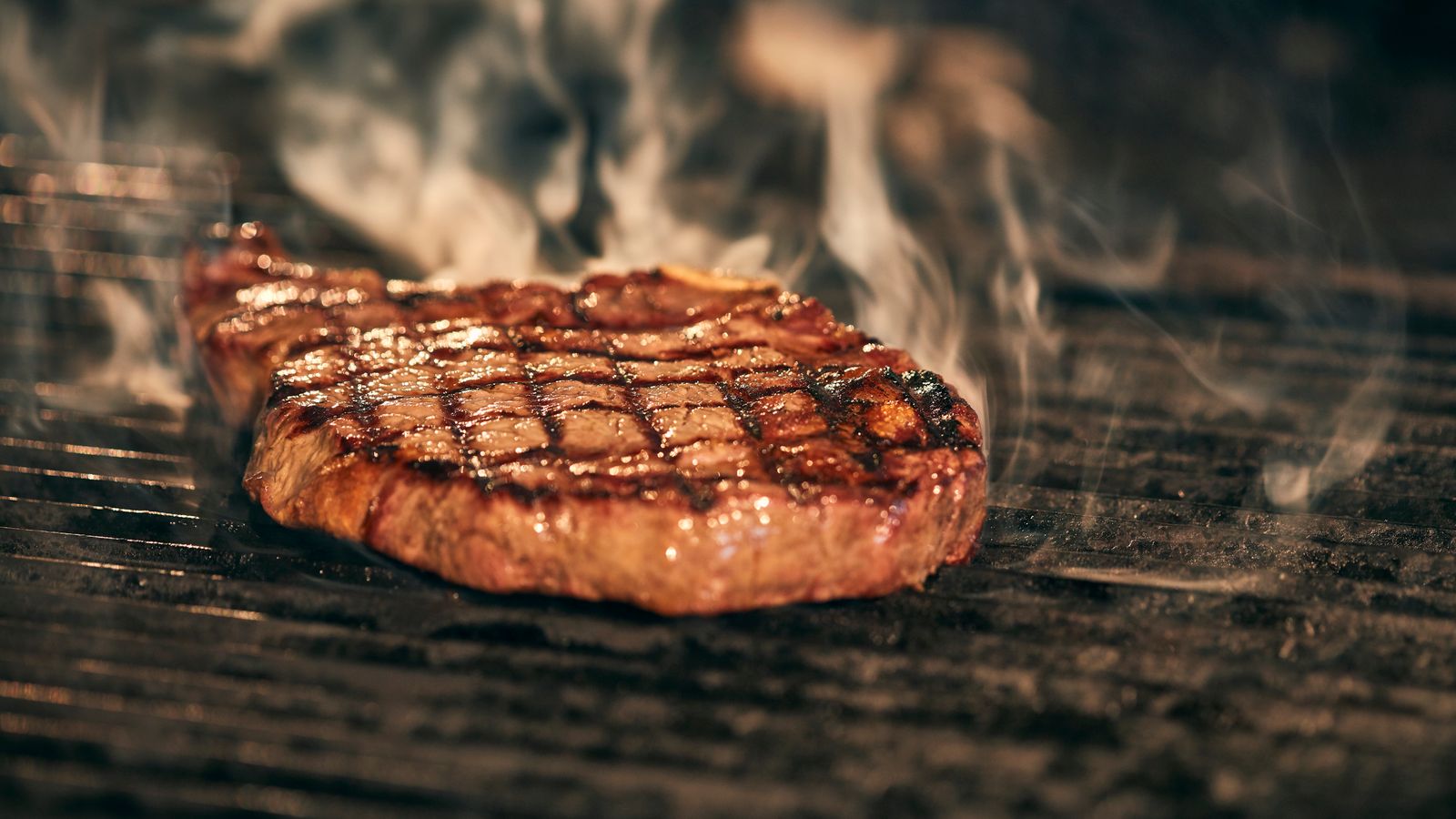
Sear 60-90 seconds per side, flipping as needed, until you've got a dark mahogany crust on all sides. This is fast — you're not cooking the inside further, just building crust (the Maillard reaction, the same browning chemistry behind good bark on any smoked meat), so stay at the grill the whole time and pull the second it looks right.
Pull the tri-tip off the sear at 130-135°F (54-57°C) internal for medium-rare, which is how this cut is meant to be eaten — any further and the lean muscle starts drying out and losing that tender bite.
Carryover heat will add another 3-5 degrees while it rests, landing you right in the medium-rare zone.
If you want a full reference for every cut and doneness level, bookmark the meat temperature chart — tri-tip runs a touch leaner than a ribeye, so don't push it to medium unless that's genuinely your preference.
All told, budget 1.5 to 2 hours from fridge-to-plate: roughly 60-90 minutes of smoke plus 5-10 minutes of active searing and resting time. That's a weeknight-friendly smoke, not an all-day project.
| Stage | Temp Target | Approx. Time |
|---|---|---|
| Smoker (indirect) | 225-250°F (107-121°C) | — |
| Pull from smoke | 120-125°F (49-52°C) internal | 60-90 min |
| Sear (direct) | 450-500°F+ grate | 60-90 sec/side |
| Pull off heat | 130-135°F (54-57°C) internal | — |
| Rest | Tented, off heat | 10-15 min |
Tent the tri-tip loosely with foil and let it rest 10-15 minutes. This isn't optional. Slicing straight off the grill sends most of the juice running out onto the cutting board instead of staying in the meat, because the muscle fibers are still contracted tight from the heat.
Fifteen minutes lets them relax and reabsorb that moisture. It's a small window compared to a brisket's hour-plus rest, but for a smaller, leaner cut it matters just as much proportionally.
Here's the part that trips up almost everyone cooking tri-tip for the first time, and it's the single most important technique on this page.
Tri-tip is actually two muscle sections fused together, and the grain — the direction the muscle fibers run — changes direction roughly in the middle of the roast.
If you slice straight across the whole thing in one direction the way you would a brisket flat, you'll be cutting with the grain on one half, and every bite from that section will be noticeably chewier, no matter how perfectly you cooked it.
Here's the fix:
Slicing against the grain shortens the muscle fibers with every cut, which is what makes the meat feel tender instead of stringy in your mouth. Skip this step and you can undo all the good work of the smoke and the sear in about thirty seconds with a knife.
CEO TIP: If you're not sure which way the grain runs, cut a thin slice off one end first and look at the exposed face. You'll see the fiber lines clearly — that tells you which direction to angle your knife for the rest of that section.
Traditional Santa Maria plates keep it plain: sliced tri-tip, pinquito beans, a green salad, salsa, and grilled French bread. No heavy sauce — the beef and the oak smoke are the point. If you want to dress it up, a simple chimichurri or a light red wine reduction works, but resist the urge to drown it in regional barbecue sauce; that's really a different regional barbecue tradition entirely, and tri-tip doesn't need the cover.
Leftovers reheat best gently, low and slow in a covered pan with a splash of beef broth, or sliced cold into a sandwich — cold tri-tip on a roll with horseradish is an underrated lunch.
Grab the free doneness + wood-pairing cheat sheet →