The quick version
The danger zone is 40-140°F, and the risk is cumulative time in it — not the length of the cook. A 14-hour brisket is safe because intact cuts are only contaminated on the surface, and that surface clears 140°F within the first 60-90 minutes on the smoker; the sterile interior can climb as slowly as it likes. Ground meat needs 160°F throughout and poultry 165°F, no exceptions. What actually makes people sick at cookouts is cross-contamination — shared plates, boards, tongs, and reused raw marinade — not the smoker temperature.
Every summer somebody's uncle announces that a 14-hour brisket smoke is "obviously" unsafe because the meat sits below 140°F for half a day. He's wrong, and he's wrong for a specific, explainable reason.
Food safety on a long smoke isn't about clock-watching the whole cook — it's about understanding where bacteria actually live on your meat, how fast they multiply, and which three or four moments in the process are the ones that matter.
Get those right and a 14-hour brisket is safer than the burger you flipped on high heat for six minutes.
This is the guide to actually understand it, not just fear it. We'll cover the danger zone itself, why whole cuts and ground meat play by different rules, the poultry number you should never round down, and the cross-contamination habits that cause the vast majority of real backyard BBQ illness — not the smoker temperature.
The "danger zone" is the temperature range between 40°F (4°C) and 140°F (60°C) where bacteria like Salmonella, E. coli, and Listeria multiply fastest. Below 40°F, bacterial growth slows to a crawl. Above 140°F, it stops and starts dying off. In between, under the right conditions, some bacteria can double their population in as little as 20 minutes.
That's the whole concept. It's not that 40-140°F is instantly dangerous — it's that every minute meat spends in that range is a minute bacteria are working. The risk is cumulative, tied to total time in the zone, not to a single temperature reading.
A brisket that passes through 40-140°F once, on its way up to a 203°F pull temp, is a completely different situation than raw chicken sitting on a counter at 75°F for two hours. Same zone, wildly different risk, because of what's covered in the next section.
This is the single most misunderstood idea in backyard food safety, and once it clicks, half of your uncle's worries evaporate.
A brisket, a pork butt, a whole chicken, a steak, a rack of ribs — these are intact muscle. Bacteria from the air, the butcher's hands, and packaging can only land on the outside surface of the meat. The interior of an intact muscle is essentially sterile until you cut into it.
That's why you can order a rare steak with a raw-red center and it's safe: as long as the exterior gets seared to a high enough temperature, any surface bacteria is killed, and the interior was never contaminated in the first place.
This is exactly why a 14-hour smoke is safe. The surface of your brisket or pork butt heats up fast — within the first 30-60 minutes on a smoker running 225-275°F, the bark is well past 140°F and climbing. The exterior clears the danger zone almost immediately.
The interior takes hours to climb through 40-140°F on its slow crawl to a 195-205°F pull temperature, but that interior was never dirty to begin with. You're not incubating bacteria in the center of the meat — there's nothing there to incubate.
Grinding takes whatever bacteria was on the surface of the trim and distributes it evenly through the entire batch. A pound of ground beef has surface-level bacteria mixed into every single bite, not just the outside.
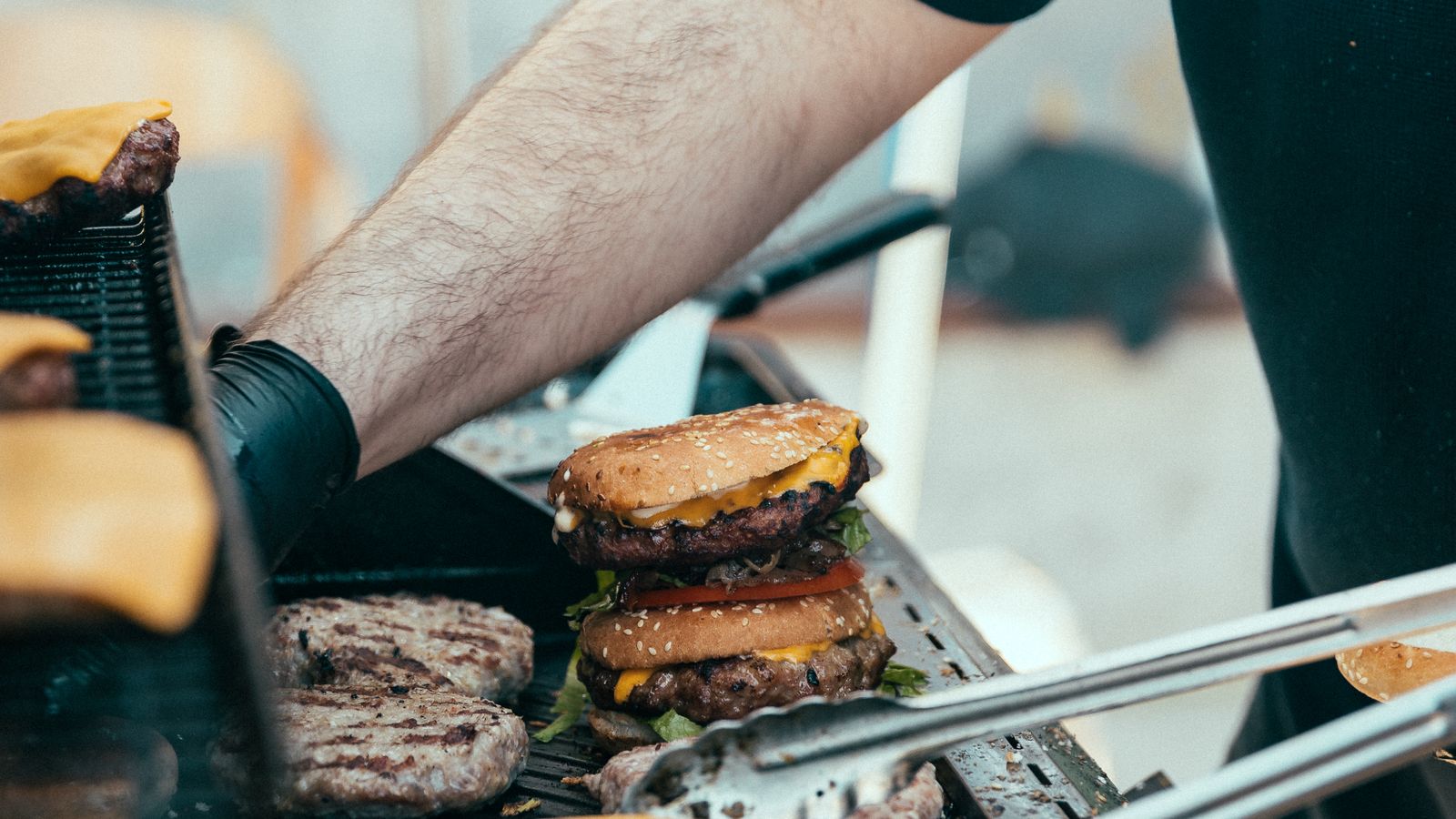
That's why ground meat — burgers, sausage, meatloaf — has a hard internal minimum: 160°F all the way through, with no gray area for pink centers, no matter how it looks. There is no "surface only needs to clear the zone" pass for ground meat, because with ground meat, the whole cut is the surface.
Check every patty with an instant-read thermometer in the thickest part; don't eyeball color, since myoglobin can stay pink even at safe temps and can also brown before it's actually done.
Same logic applies to anything mechanically tenderized (blade- or needle-tenderized steaks, common with cheaper cuts) — the tenderizing process pushes surface bacteria into the interior with tiny blades, so those cuts need to be cooked like ground meat, to a full 160°F, not treated like an intact steak. Check the package label; tenderized cuts are required to say so.
Poultry gets its own number because Salmonella and Campylobacter are common enough on raw chicken and turkey that USDA guidance sets a single hard minimum: 165°F, measured in the thickest part of the breast and inner thigh, away from bone.
This applies whether you're doing a spatchcocked bird on the smoker, whole wings, or a holiday turkey — 165°F, no exceptions, no "it's basically done." Poultry connective tissue and skin also benefit from carrying past that number into the low 170s-180s for better texture, but 165°F is the safety floor, not a suggestion.
Standard food-safety guidance (the FDA Food Code's "4-hour rule"): perishable food shouldn't accumulate more than 4 cumulative hours between 40-140°F before it's either fully cooked, refrigerated, or held hot. Note the word cumulative — it's not 4 hours per session, it's 4 hours total across the whole time from fridge to plate.
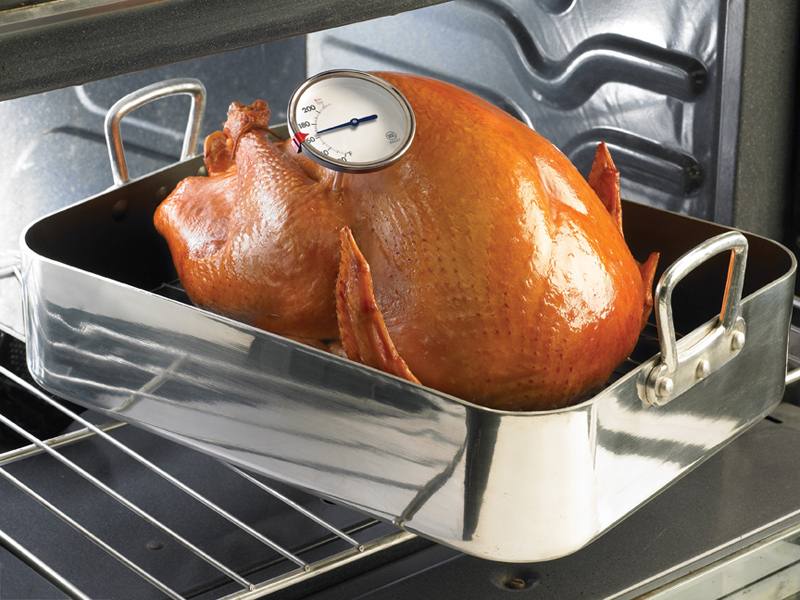
Here's why a long smoke doesn't come close to breaking that rule even though the cook itself runs 10-14 hours: the clock only counts time the meat itself is actually in the 40-140°F range, and for a large roast that's a small fraction of total cook time.
On a whole brisket or pork butt, the surface — the only contaminated part — clears 140°F within the first 60-90 minutes on a smoker holding 225-250°F. The sterile interior takes hours to follow, and that's fine: bacteria live on the outside of intact muscle, not in it.
After that, everything from 140°F upward is outside the danger zone by definition, even while the center is still climbing. A whole chicken clears the zone even faster because it's smaller and thinner.
The "it's in the zone for hours" fear conflates total cook time with actual danger-zone time, and they are not the same number.
Where the 4-hour rule actually bites people is the front end: meat sitting out on the counter to "come to room temperature" before cooking, or sitting in a hot car on the way to the cookout. That counts against your 4 hours just as much as time on the smoker, and it's fully avoidable.
CEO TIP: Start your smoke with meat straight from the fridge, not rested on the counter. Cold meat doesn't cook any slower in a way that matters, and every minute you "let it warm up" on the counter is a minute burned from your 4-hour budget for free.
Everything upstream of the smoker matters as much as the cook itself.
Buy a cheap fridge thermometer and check it — many home fridges run warmer than their dial suggests, especially when packed full before a cookout. 40°F or below keeps raw meat's bacterial clock essentially paused.
A frozen brisket or turkey thawing on the counter warms unevenly: the outside can sit in the danger zone for many hours while the inside is still frozen solid, which is exactly the slow-surface-warming scenario that's actually risky.
Thaw in the fridge instead — budget roughly 24 hours per 4-5 pounds, so a 12-pound brisket wants 2-3 days, and a 14-pound turkey wants closer to 3-4 days. In a pinch, a cold-water thaw (submerged, sealed, water changed every 30 minutes) works much faster and is still far safer than the counter.
Never thaw at room temperature, full stop.
If you're prepping at home and transporting meat to a cookout site, or just keeping it staged near the smoker before it goes on, treat it like a cooler item: raw meat sits in a cooler with ice, not on a picnic table in the sun.
This matters even more if you're seasoning ahead of time — a dry-rubbed brisket or a cut going through a wet or dry brine the night before still needs to stay at or below 40°F the entire time, fridge or cooler, until it hits the fire.
If you dig into actual foodborne illness case reports from backyard cookouts, the cause almost never turns out to be "the smoker ran too cool." It's cross-contamination — raw meat's bacteria getting onto food that isn't going to be cooked again.
Use one cutting board and one set of tongs for raw meat, and a completely different set for anything cooked or ready-to-eat — buns, cooked meat coming off the smoker, that plate of sliced tomatoes.
The classic mistake: carrying raw chicken out to the grill on a plate, then using that same plate to carry the cooked chicken back inside. The cooked chicken just picked up every bit of raw bacteria that was on the plate. Bring a clean plate out, or at minimum, wash the plate between trips.
Marinade that's touched raw chicken, pork, or beef is now contaminated with whatever was on that meat's surface. If you want to use it as a basting sauce or serve it as a dip, it has to be brought to a full boil first to kill off what's in it. Otherwise, set aside a separate, untouched portion of marinade before the raw meat ever goes in, specifically for basting and serving later.
This is also where a good instant-read thermometer earns its keep — it's the only tool that actually tells you when meat has cleared its safety threshold, rather than relying on color, juice clarity, or "it's been on long enough." Check the the meat temperature chart for exact safe minimums and preferred doneness ranges by cut, and never rely on a stall-era guess when you're this close to done — see low and slow smoking fundamentals if the science of that long plateau is new to you.
| Situation | Safe minimum internal temp | Why |
|---|---|---|
| Ground beef, pork, sausage, burgers | 160°F throughout | Bacteria mixed through the whole cut by grinding |
| Whole poultry, parts, ground poultry | 165°F | Common Salmonella/Campylobacter risk on raw poultry |
| Whole/intact beef, pork, lamb cuts (steaks, roasts) | 145°F (surface sear is what matters for rare centers) | Interior is sterile if surface is properly seared/heated |
| Reheated leftovers | 165°F | Treat as a fresh cook — bacteria may have regrown in the fridge |
| Held hot (faux-cambro, warming tray) | Above 140°F, continuously | Stops bacterial growth without continuing to cook the meat |
Wrapping a finished brisket or pork butt in towels inside an empty cooler — a "faux cambro" — to hold and rest for two, four, even six hours is a standard, safe technique, as long as the meat stays above 140°F the whole time.
A properly insulated cooler will hold a 200°F brisket well above that floor for hours. If you're worried, check it with an instant-read thermometer at the two-hour mark; a well-packed faux cambro barely loses ground.
This is completely different from leaving food out uncovered at room temperature — the cooler's whole job is keeping the meat out of the danger zone, not letting it drift into it.
Cooked brisket that's been through a cool-down and a night in the fridge doesn't get a pass on reheating just because it was "already cooked once." Treat leftovers like a fresh cook: reheat to 165°F internal before eating, whether that's in an oven, a pan, or back on the smoker.
This matters because bacteria that survived the cooling process (or landed on the food afterward via cross-contamination) can multiply again in the fridge over a few days, and reheating is your last checkpoint to knock that back down.
Don't smoke meat halfway, refrigerate it, and plan to finish the cook the next day.
Partial cooking can bring meat into the 90-110°F range — prime bacterial growth territory — and hold it there for an extended stretch without ever reaching a temperature that kills anything off, then send it into the fridge still carrying whatever grew during that window.
If you can't finish a cook in one session, cook it fully, cool it properly, and reheat it fully later — don't stop it partway through.
Grab the free doneness + wood-pairing cheat sheet →None of this should make you nervous about a long cook. If anything, understanding the actual mechanism should make you less nervous about your brisket or pork butt sitting on the smoker for half a day, and a lot more alert to the plate-and-tongs mistakes that actually cause problems. If you're still building your first-cook habits, bake these into your routine now, before they're habits you have to unlearn.